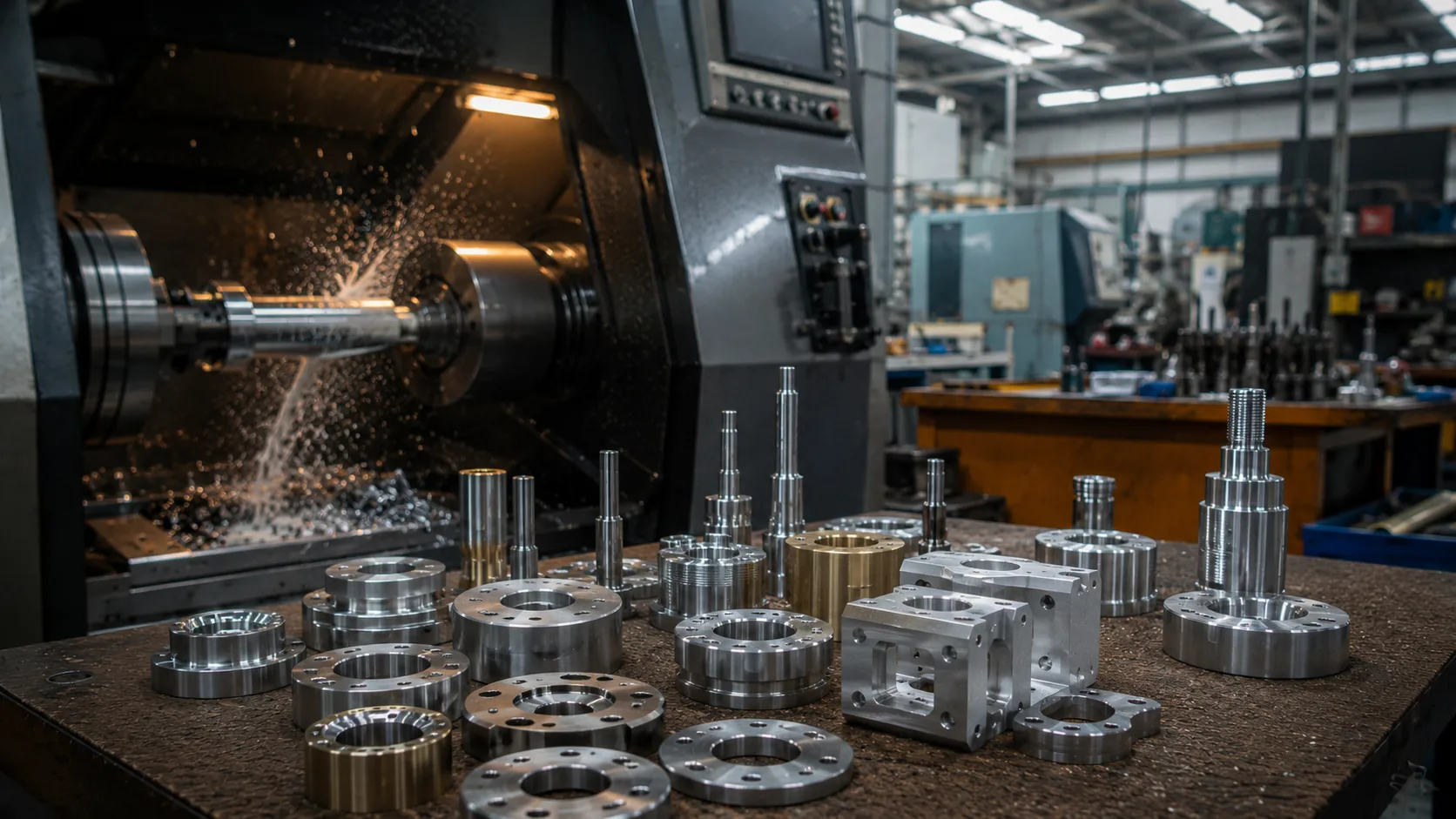
India is one of the most competitive sources for CNC machined parts in the world. With established manufacturing hubs in Coimbatore, Pune, Bangalore, Rajkot, and Ludhiana, buyers can access precision machining at 30–50% lower cost than equivalent European or North American suppliers — without sacrificing tolerance capability or surface finish quality.
But sourcing from India manually is slow and inconsistent. Most buyers search IndiaMART, collect 3–4 quotes, and pick the cheapest — missing better options, overlooking certification gaps, and often paying more than they should because they did not compare enough suppliers.
This guide covers what you actually need to know: which hubs produce what, realistic cost benchmarks, lead times by order size, what certifications to demand, and the red flags that signal a supplier will waste your time.
The Five Main CNC Machining Hubs in India
Not all Indian manufacturing hubs are equal. Each specialises in different industries, materials, and tolerance ranges. Matching your requirement to the right hub cuts lead time and cost significantly.
- Coimbatore, Tamil NaduIndia's precision engineering capital. Strong in high-tolerance CNC turning and milling, pump components, textile machinery parts, and aerospace-grade aluminium work. ISO 9001 certification is common; AS9100 suppliers exist for aerospace buyers. Best for tight tolerances (±0.01mm) at competitive prices.
- Pune, MaharashtraAutomotive and hydraulics hub. Dominant in hydraulic cylinders, valves, pump housings, and automotive transmission components. Strong tier-1 and tier-2 supplier ecosystem with IATF 16949 certification. Best for medium-to-high volume runs of complex assemblies.
- Bangalore, KarnatakaAerospace and defence precision machining. Many suppliers hold DGCA approvals and NADCAP accreditation. Higher pricing than other hubs, justified by tighter process controls and material traceability. Best for safety-critical components where documentation is non-negotiable.
- Rajkot, GujaratCost-optimised casting, forging, and general machining. Lower overheads, large number of small-to-medium shops. Best for cost-sensitive, less complex components where price is the primary driver and tolerances are ±0.05mm or wider.
- Ludhiana, PunjabMachine tools, spindles, fasteners, and industrial tooling. Decades of tooling expertise. Competitive pricing on standard components and catalogue parts. Best for tooling procurement and standard industrial hardware.
Cost Benchmarks: What to Expect
Pricing in India is highly dependent on material, complexity, tolerance, and surface finish. These are indicative ranges based on real quotes — not catalogue prices.
- Simple turned parts (aluminium, ±0.05mm)₹80–₹250 per piece at MOQ 50+. Equivalent European cost: €3–€8. Savings: 40–55%.
- Complex milled components (steel, ±0.02mm)₹400–₹1,200 per piece at MOQ 25+. Equivalent European cost: €15–€40. Savings: 35–50%.
- Hydraulic cylinder bodies (EN8/EN24 steel)₹2,500–₹8,000 per piece depending on bore size and length. MOQ 10–25 pieces.
- Aerospace aluminium brackets (6061-T6, tight tolerances)₹1,500–₹4,500 per piece from Bangalore or Coimbatore aerospace shops. Price rises significantly below MOQ 10.
- Casting + machining (grey iron, ±0.1mm)₹500–₹3,000 per piece from Rajkot or Coimbatore foundries. Lead time includes pattern development on first order.
Always request a DFM (Design for Manufacturability) review before finalising. Indian suppliers rarely volunteer concerns upfront — a quick review can identify features that add 40–60% to machining cost unnecessarily.
Realistic Lead Times by Order Type
Lead times from Indian CNC suppliers are frequently misquoted. Suppliers often quote aggressive timelines to win the order, then push back after PO. Factor in the following realistic ranges:
- Sample / prototype (1–5 pieces)10–21 working days for most turned or milled parts. Complex parts or those requiring special material procurement: 25–35 days.
- Small production run (25–100 pieces)18–35 working days. Castings with pattern development add 3–4 weeks on first order only.
- Medium production run (100–500 pieces)25–45 working days depending on complexity and shop capacity.
- Large run (500+ pieces)40–60 working days. Suppliers with dedicated capacity can reduce this if booked in advance.
- Shipping to Europe / North AmericaSea freight adds 25–35 days. Air freight adds 5–8 days at 8–12x the cost. Factor this into total lead time for project planning.
Ask for a detailed production schedule broken into raw material procurement, machining, QC, and dispatch milestones. Suppliers who cannot provide this have no production planning visibility — a red flag for anything time-critical.
Certifications to Demand Before You Order
Certification requirements vary by industry, but these are the minimum checks every buyer should run regardless of application:
- ISO 9001:2015Baseline quality management. Should be current and audited within the last 12 months. Ask for the certificate — not just a logo on a website.
- Material Test Reports (MTRs)Critical for any structural, pressure, or safety-related component. The MTR must match the heat number on your parts. Non-traceable material is a rejection risk at your customer's goods-in.
- Dimensional Inspection ReportsRequest a First Article Inspection (FAI) report on your first order. Suppliers with in-house CMM capability can produce this. Those without CMM are limited to manual gauging — acceptable for lower tolerances, insufficient for ±0.01mm work.
- IATF 16949Mandatory if parts enter an automotive supply chain. Do not accept ISO 9001 as a substitute for IATF on automotive work.
- Surface treatment certificationFor anodised, plated, or coated parts, verify the treatment shop is separate from the machining shop. Ask for hardness and thickness test reports per batch.
Supplier Red Flags That Cost Buyers Money
After reviewing hundreds of supplier responses, these are the patterns that reliably indicate problems before the first shipment arrives:
- No factory photos or only stock imageryLegitimate machining shops have real equipment photos. Traders posing as manufacturers cannot show their own floor.
- Quote within 2 hours of receiving a complex drawingA genuine CNC shop needs time to review tolerances, calculate cycle times, and check material availability. A quote in 2 hours on a complex part is a number pulled from thin air.
- "We can do any tolerance" without specifying machine capabilityAsk for the machine list and capability statement. A shop with 15-year-old manual lathes cannot hold ±0.005mm regardless of what they quote.
- Reluctance to sign an NDA before receiving drawingsAny supplier unwilling to sign an NDA for your technical drawings is not serious about confidentiality. This matters especially for proprietary parts.
- Payment terms: 100% advance onlyEstablished shops offer 30–50% advance with balance on inspection or dispatch. 100% advance with no negotiation is a cash flow problem on their end — or worse.
- No response to technical clarification questionsIf a supplier cannot answer specific questions about their process — feeds, speeds, fixture approach, inspection method — they are unlikely to produce your part correctly.
The cheapest quote is rarely the lowest total cost. Factor in rejection rate, rework cost, re-shipping, and delay impact when evaluating supplier bids.
How to Actually Find the Right Supplier
Manual supplier search on IndiaMART or TradeIndia surfaces the suppliers who spend the most on advertising — not the best manufacturers. The platforms are flooded with traders, middlemen, and shops that list capabilities they do not have.
A structured supplier search should cover at minimum: IndiaMART, TradeIndia, JustDial, MSME cluster directories, export promotion council databases, and direct outreach to manufacturing associations like IMTMA (Indian Machine Tool Manufacturers' Association) and CII.
At ProcureIQ Atlas, we search live across 47 countries per requirement — no stored database, no pre-approved panels. Every search is scoped to your exact specification: material, process, tolerance, certification, and geography. We rank the top three suppliers by cost, lead time, certification status, and supply chain risk, and deliver the intelligence report within 24 hours.
If you have a drawing or RFQ ready, submit it at procureiqatlas.in/quote. If you want to understand what a report looks like before committing, email us at team@procureiqatlas.in and we will walk you through a sample.
Frequently Asked Questions
How much cheaper is it to source CNC machined parts from India?
Buyers typically see 30–50% cost savings compared to European or North American suppliers, depending on part complexity, material, and order volume — without sacrificing tolerance capability or surface finish quality when the right hub and supplier are matched to the requirement.
Which Indian city is best for high-tolerance CNC machining?
Coimbatore, Tamil Nadu is India's precision engineering capital, capable of holding tolerances down to ±0.01mm. Bangalore is the next best option for aerospace-grade work requiring NADCAP or DGCA-approved suppliers.
What is a realistic lead time for a CNC machined prototype from India?
10–21 working days for standard turned or milled prototypes. Complex parts or those needing special material procurement can take 25–35 days. Add 5–35 days for shipping depending on air or sea freight.
What certifications should I verify before ordering from an Indian CNC supplier?
At minimum, a current ISO 9001:2015 certificate verified against the certifying body's registry, Material Test Reports matching the heat number on your parts, and a First Article Inspection report on the first order. Automotive parts require IATF 16949, not just ISO 9001.
Ready to source smarter?
Upload your RFQ or drawing. We search live suppliers across 47 countries, rank by cost, lead time, certifications, and risk — and deliver your intelligence report within 24 hours.